NOTE: This blog has moved to www.developeconomies.com
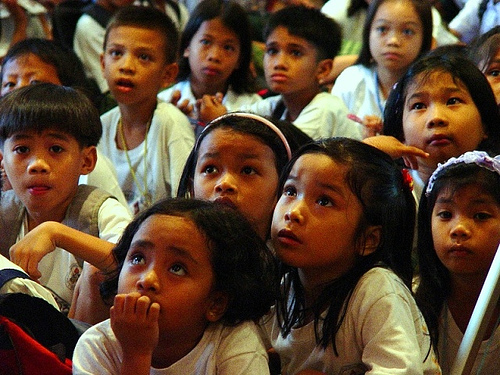 In this journal, I have discussed the relationship between education, poverty alleviation, and economic development. The link is critical and the three are self-reinforcing. Education creates greater opportunities for the youth, who go on to work decent jobs in cities like Bacolod, Manila, and Cebu. The children remit money back to the parents, who spend on home improvements and the tuition fees for the younger siblings. College-educated individuals are much less likely to end up impoverished (about 1 in 44). Trade schools also create opportunities, with only one in 10 people with post-secondary degrees living below the poverty line. Unfortunately, the ratios drop precipitously after that. One in three high school graduates and half of elementary school grads are impoverished. Here are the sobering education statistics:
The long-term outlook for poverty reduction doesn’t look good either, unfortunately. We all know that there is a very strong link between education (or lack of education) and poverty—two-thirds of our poor families have household heads whose highest educational attainment is at most Grade 6. Well, the education statistics (all from the NSCB ) tell a very sad tale: elementary school net participation rates (NPR)—the proportion of the number of enrollees 7-12 years old to population 7-12 years old—have plummeted from 95 percent in school year (SY) 1997-98 to 74 percent in 2005-2006, as have high school NPRs.
Cohort survival rates (CSR) have also dropped: Out of every 100 children who enter Grade 1, only 63 will reach Grade 6, down from 69 children in 1997-1998. In high school, CSR have dropped even more: from 71 to 55. Which means, of course, that school dropout rates have increased. Which is one of the reasons why, in 2005-2006, for the first time in 35 years, total enrollment decreased in both elementary and high school: although private school enrollment increased, public school enrollment went down more.
The correlation is not difficult to see, but fixing the problem presents a challenge for several reasons. According to some observers, the Department of Education Culture and Sports (DECS) in the Philippines is one of the most corrupt government entities in the country. It has a budget equal to 12% of spending, but is riddled with graft from procurement (buying textbooks and other supplies), grease money, and bribes for just about any sort of movement within the bureaucracy. The impact on the education system is detrimental:
Embezzlement, nepotism, influence peddling, fraud and other types of corruption also flourish. Corruption has become so institutionalized that payoffs have become the lubricant that makes the education bureaucracy run smoothly. The result: an entire generation of Filipino students robbed of their right to a good education.
This corruption leads to poor allocation of resources. Teachers are underpaid and treated poorly. In 2005, the Philippine government spent just $138 per student, compared to $852 in Thailand, another developing country in Southeast Asia. But graft and corruption are not the only issues. Poverty is a vicious cycle that leads traps generations of families.

Lunchtime at “The Environment-Friendly School”
About 80% of the Filipino poor live in the rural areas of the country. These are towns located deep in the mountains and the rice fields. The population density in the rural parts of the country is low, and there is a corresponding deficiency in schools and classrooms. Public school is free, but families still cannot afford to send their children for a complicated network of reasons. In this editorial for the Pinoy Press, one author delineates the key issue:
With around 65 million Filipinos or about 80 percent of the population trying to survive on P96 ($2) or less per day, how can a family afford the school uniforms, the transportation to and from school, the expenses for school supplies and projects, the miscellaneous expenses, and the food for the studying sibling? More than this, with the worsening unemployment problem and poverty situation, each member of the family is being expected to contribute to the family income. Most, if not all, out-of-school children are on the streets begging, selling cigarettes, candies, garlands, and assorted foodstuffs or things, or doing odd jobs.
 Beyond the selling goods on the street, children in farming families are expected to work in the fields during harvest time. In agriculture-based communities where farming is the primary livelihood, having children around to help with the work means more income for the family. In a recent trip to Valladolid, someone told me that children are paid 15 pesos for a day’s work in the blistering heat. They are pulled from school for two or three months at a time and are irreparably disadvantaged compared with their classmates. So, they may have to repeat the grade, only to be pulled out of school again next year.
Transportation is another big problem. Kids walk 2-3 kilometers or more to and from school every day. They have to cross rivers and climb hills with their bookbags. The ones that can afford it take a tricycle, but that is a luxury. Schools are sometimes too far for the most remote communities to practically access. So the families can’t afford to pay and the children are pulled from school.

The walk to school.
It seems like an intractable problem. Corruption in the education bureaucracy and a lack of resources make delivering a high-quality education to all Filipinos a challenge. Microfinance is one way to help. With the assistance of microcredit loans, women can pay for the education of their children – to purchase uniforms, textbooks, lunches, and rides to school. Also, by creating another source of income other than farming, the children do not have to come help the family work the fields. When I talk to NWTF clients about their dreams, they unfailingly say they hope for their children to “finish their studies.” History has shown that it is an achievable goal. But real systemic change needs to come from above. As long as corruption and bureaucracy paralyzes the system, the goal of delivering a decent education to children – which pays dividends to the country in the long run – will remain out of reach.
For the rural poor, non-profits exist to help in the mission of education. While looking up pictures for this post, I came across a Filipino organization called the Gamot Cogon (“Grass Roots”) Institute:
The Gamot Cogon Institute (a non-stock, non-profit organization) is an Iloilo-based cultural institution working to transform society through human development approaches including education and training. GCI also prototypes or demonstrates alternative approaches to education, agriculture, health, and full human development.
Very cool stuff.


 Josh Weinstein
Hey Josh, I’m a friend of Adam Pearse, who recommended I check out your blog. I enjoy your perspective, and I am actually volunteering (from afar) to help an education NGO in India that attempts to tackle this same problem, albeit primarily in more densely inhabited slums. Gyan Shala provides primary education at a fraction of the cost of public/private counterparts by spending more on creating detailed curricula, learning plans/worksheets, teaching aids, etc. and less on teachers, devolving primary teaching responsibilities to high school passouts in the local community under the mentorship of more senior teachers. The educational outcomes are strong (superior to their counterparts, except for the very expensive private schools), and the majority of students served come from families living on less than $2 a day. The cost of education a child per month works out to about $4-$5, thanks to the low cost of high school passout labor, and using space in the local community (reducing transit time as well) rather than central schooling facilities.
Out of curiosity, what is the average wage for a high school passout in these areas in the Philippines and what is the typical class size?
Hey Chris. I’ve been meaning to respond to you about this for a while. First, thanks for checking out the blog. It’s always good to hear from other people doing development about the work theyre doing. I’m not sure I know what a high school passout is. Is that a dropout? If so, its likely very low. There is an abundance of labor in the Philippines and not enough jobs. Unemployment among unskilled labor, in particular, is high. The class sizes are a major issue. A couple months ago there was an article in the new york times about the classroom shortage in the philippines. it is a fast growing country – 70 million to 95 million in a few decades – and the department of education, due to a mixture of funding deficiency and corruption, is not keeping up. there might be 100 kids in an elementary school classroom that seats 80. in the philippines, it is written nto the constitution that education must be the #1 priority of the country, and this is what every politician promises. And without fail, every politician fails to keep that promise. Solutions in the urban slums are probably different than in the rural farmland, but it sounds like you are doing some pretty innovative and effective, given the constraints.
yeah guys!<3
Fascinating post. It would be interested to see the percentages of dropouts within other Asian developing countries as well as those in other regions such as South America and central Asia. It would also be interesting to see the breakdown in numbers from rural to urban. In China, some of the cities have an 80-90% high school graduation rate with equally high percentages going to colleges while in the rural areas the numbers are much worse.
Clearly education is the only way out of the poverty cycle which is why China is so quickly advancing. Interestingly, in some of the inner cities of the US, there are similarly striking dropout rates (not in elementary school but in middle school and high school) with similar end results in terms of poverty, unemployment and inability to get out of a cycle of poverty, poor child-rearing etc.
Thank you so much for sharing your article. It is very informative. Most of all for giving yourself to this noble endeavor
A sobering post. Its underlying assumption, that investment in education will raise people out of poverty, seems so self-evident as to be hardly worth questioning, but William Easterly’s book “The Elusive Quest for Growth”, does question it. He points out that a number of studies have looked at the rapid growth in education expenditure in African countries in the period 1960¬¬–1985, including Angola, Ghana, Madagascar, Mozambique, Senegal and Sudan, and have found very little correlation with GDP growth per capita, although there does seem to be a correlation between initial rates of schooling and subsequent productivity growth.
Having said that, no country has become rich with a universally unskilled working population, so there has to be investment in education. However, there also have to be economic incentives beyond nursing jobs overseas to make sure that there is a pay-off from the investment. This is what China has done, as you point out in another of your recent posts.
As with so many social and economic issues any gains in education are inevitably wiped out by rapid and unsustainable population growth. Take physical infrastructure. There has been little investment in new schools in the last 30 years, which means that schools that were built to educate the young of a national population of 48 million (1980) now have to accommodate the children of population of 93 million (2010). Is it any wonder then that class sizes are 100 or more?
Finally, I completely agree that it is the ancillary costs of schooling that deter many parents, which is why richer local governments, such as that in Makati, offer help with uniforms, books, etc. Helping poorer families meet these costs has to be part of a national education policy.
Hi Torn – thanks for responding to my post. I will look into more of William Easterly’s writings this week. It doesn’t surprise me that education spending does not correlate to development. The United States has some of the highest per capita spending on public education, yet it is in the bottom third of developed countries in terms of student performance. Like anything in education and development, it is not how many dollars you throw at a problem, but how those dollars are used that counts. A start would be to raise teacher pay, introduce more accountability in education spending, and invest in infrastructure, like you say. Even though public school is supposed to be free, students in many parts of the country still have to pay to attend. It is a difficult problem, since it is difficult to quantify impact and the payoff is long-term. We still haven’t figured out the right education policy in the U.S., so it isn’t just a developing world issue.
Also, I read your response to my post about China as well, and I think you offer some good rebuttals of my argument. You are much more knowledgeable than I about the history of politics in the Philippines, so I look forward to reading your blog.
Hi Josh, I fell in love with a filipina a few years ago and since then I spend about half the year near Cebu City. Education in the Philippines could definitely use some help so Rhea and I have started a paid newsletter at http://www.paradiseinphilippines.com and use 75% of the proceeds to help support the education of children there in Cebu.
It’s such a beautiful country but there’s a lot of work that needs to be done.
is there any regions here in the Philippines where you conduct your research?
I’m very interested about the article,I’m a college student of Ndmu, I find your article a great source of our research….our topic was EDITIFICATION IN INACCESIBLE VICINITY..
thank you for this one Sir. This really hepls me to my proposal.
hey josh,thanks for the post.this the reality what all about the education here in philippines.the really problems here is the government on how the politics work despite of arising problems especilly on education. Many of the students walk for how many kilometers from their house without shoes or even slippers due to poverty. We have a lot of good in teaching but luckily poor in support from the government. I think it should start from the leaders of my country to able deliver the needs of my fellows. I also one of the leaders here in our barangay or just a small town. I really want to help them but how can I, Im not a reach person that can really help them. I just only work for the good of my people by helping them the best that I can be and we really need the NGO,s that can help and subside the problems arising. I can see in the future that there is a hope waitong for them.thanks..
HI Josh,
Hi Josh,
I am a public elementary teacher in a rural and depressed area in Negros occ., thus i am happy to hear about your concern to us most especially the educaation condition here in the Philippines. 2010 new president had put up an alternative to eleminate drop out most especially on our indigents pupils. the program is the 4P’s or (Pantawid Pamilyang Pilipino Program) one of the concerns is giving allotment to the family in cash for the studies of their children. thus, this program really keeps our pupil back and continue going to school. I hope and pray that this will continue and 100% of my pupils will be benifited by this. I had a great number of pupils every school days…….
thanksssss
hello sir… your article is definitely interesting!!
I was wondering if there are existing programs to help solve such problems? Please give me an idea.. I am very much interested with this particular topic. thank you so much.
Hello Josh,
I am a public school teacher in the Philippines, I just want to add that one of the programs of Department of Education (DepEd) to eradicate illiteracy and decrease the number of out of school youth/adults is Alternative Learning System ( ALS) a Non Formal Education system. As mobile teachers we go to different remote and depressed areas to teach those who can’t afford formal schooling. We are aiming Education For All (EFA) 2015, hoping that in the years to come all Filipinos are well educated.
I plan to spend July near San Remigio and Butuan City. I have spent the last 44 years working on, I believe, a similar situation in northern Canada. I hope you are still in Alternative Learning Systems — I would really like to exchange ideas, maybe even meet.
Hello Josh,
Thank you very much for your article, it shed light to my gloomy mind on how to go about my qualitative discussions on my research study for my dissertation.I’m now discussing why pupils survived and did not survived on time. You really gave me the signal to go on with my plans on how to present my findings. I conducted the study on the City of Kidapawan. It was so touching to have witnessed the real situation of the pupils who drop out from school because of poverty due to big family size and other factors. I really have a lot to share to you after my oral defense, but as of now, let me say good luck to your study.
this article made me realize one thing……
CORRUPTION is the root of all these problems that the education sector of our country is facing right now.
I live in Suriname, as the only dutch speaking nation (450.000 people only) on the continent of south america.Colonialism has shaped the Surinamese people for what it is now: indians immigrants 1873 from India- Negroes from Ghana (former slaves, salvery abolished in 1863)- marroons (runaway slaves in remote areas) armor Indians ( 7000 ) javenese immigrants from Indonesia etc….. we are a melting pot and our cultue heritage is not a threat but a source for development.We live in relative peace with each other.If i say that there is a synagogue next to a Mosk then i have said it all.
The problem:
the marrons and the armor indians live in a remote area. different villages exist of 200 to the biggest 2000 people.55% are youngsters….
the villages are with a motor small boat 30 minutes to 2 days away from each other.
the marrons and indians are fom different etnic background with their own religions etc……….which makes clustering a p r o b l e m.
the results are so bad. e.g 22% pass the exams for the primary schools.
the boys are focussed on making money due to the high gold price.
this is a other problem we face in suriname
Hello! May I know where is the place of this school? cause we have a project about education. thank you! ^_^
hi josh, im james from Mindanao State University at Naawan taking up Bachelor of Elementery Education. . .this blog about The Problem of Rural Education in the Philippines may help my Research study, if you dont mind if i use this for one of my source in my study, but i did not finalize my title yet and i am just asking your permission if i needed this journal for one of my literature cited. it would be a great help for me. sorry for the wrong spellings and wrong grammar. I’m inspire about your blog. May God bless you always..
this is a great discussion this thing made me realize that i really need to study for me to be able to help my fellowmen someday !:)
thank you for a documentary type of report on phil education situation. there are outstanding aspects that need to be addressed being perennial: curriculum timeliness, teacher factor, student factor, school facilities, geographic location, funds, bureaucracy, population explosion and school management.
All countries are corrupt; it’s just that Philippines doesn’t know how to hide their dirty linens in public.
I find your article very informative and useful. It is true that the country suffers from the lack of quality education. Though a lot of kids are eager to learn, they cannot go to school because they have other priorities like tending to a farm or working to supplement family income.
As this is also my topic for a school project, can you provide other source materials that I can look into to further my research. Your help will be much appreciated. 🙂
dear Josh its good that your able to write something about the current situation of the Filipino educational system in rural areas in the Philippines this article is a big help in my study on rural based school.
ya i totally agree with you. thanks alot this article helped me soo much with ,y school work! way to go Josh!
It might be good to point out that the declining quality of education in the Philippines is not at all about the shortage of classroom or the said corruption of public officials. I have to say that most of our people become very much pragmatic about how they would be alleviated from poverty and thus be able to give their children good education. They go to the extent of blaming the government for its failure to provide them with this and that. Ironically, they fail to realize that what they really need is not the bulk of budget to be fed to them but the degree of discipline and determination they must have to drive their children to keep going to school. There will always be the failure to improve the participation rate, number of students who successfully graduate, and the number of those who become employed, because at the grass root we fail to cultivate that discipline.
hi Josh! Im an elementary grade teacher and I simply love your article. I’m currently working on my research for my course requirement. This article is such a great help.tanx and gudluck!
tnx for the information u given to us especially we are a student it is a way that we must study so that we can help the country be a successful..
this article is a big help for me for me thesis 🙂
A motivating discussion is definitely worth comment. I do believe that you need to publish more on this subject matter, it may not be a taboo matter but generally folks don’t discuss such issues. To the next! Many thanks!!
i find your blog very interesting :)) my topic is about RURAL AREA TEACHERS in the Philippines could you please give me some advice on how I can make my end-of-term interesting like yours ? :))
hello, thanks for the article. hope this will help my research.
It is really an interesting blog. Thanks for the post Josh, really helping.
yeah, now there is k-12
thanks for this post, By reading this blog, it really helped me in coping some ideas for my essay assignment 🙂
Hi. Thanks for writing this. I’m work for an education non-profit that provides college scholarships for students in the Philippines. This blog made some great points. May I ask what the sources of your data and statistics were?
Thank you again!
-Racquel
It’s so sad that a big portion of the responders are thanking you for the help they’re getting in their ‘researches’. I hope that there is an underlying cause to all these, a desire to help cure the problem no matter how small.
Amazing! Its genuinely amazing post, I have got
much clear idea on the topic of from this piece of writing.
Greeting there! Would you remember if I assets your blog with my twirp foregather? There’s a lot of people that I anticipate would truly relish your proportion. Please let me jazz. Cheers.
Everything is true. Very informative truth of Philippine education.Finished my grade and hischool with hardship. College while working. The corruption is too wide like a flooding river one cannot stop it. So I do it in my little way..help the kids thru seminars, symposium, dialogues….at least they receive and learn some good things than wait for the government to do its role.. you can help further and farther…..help those who selflessly try to help the kids learn the basics in school…and later they can replace the crooked leaders. My salute to your endeavor…..
Hi, Mr. JOSH WEINSTEIN. i”m glad and really appreciate this article of you about rural education. You know what, when i read your article. I’m really hoping that this study of yours would reach the attention our philippine officials and concern citizens in our country, who are affoard to help the unfortunate situations of the learners there , To lend their help, because in order to go to school some learners in rural area really pass through rough roads, rivers and some are really walk very far from mountain for them to be able to and lean to school. And sometimes their calvary not only lie on tnese, because another things regarding these are the lack of reference in school like good and new books, and also poor classroom facilities.
By the way Mr. Weinstein, I admit hat i’m not that good in english but i hope that you understand my appreciation for your conducted study, here in our country. actually im an education students, searching for the issues in education im looking for our theses topic and title, then i found your website. GOD BLESS YOU!
hi! Mr. Josh i read about the blog, for me it is very interesting and inspiring especially i am student of college of teacher education. … i hope this blog will help the leaders of our country to realized that education is very important and compulsory to achieve by individual. i hope that they will focus to those children who can not afford expenses in school, and teachers who are willing to teach but luck of support from the government and official as well.
i salute also those teachers who commit their lives in teaching and to those students especially in the isolated area of our country it is difficult for them because they suffer any kind of hindrances like they need to walk a miles, climb mountains lack of materials in school etc, but still they pursue to teach and learn ….again thank you this will serves as inspiration not only to us but in entire country who will read this blog about Problem of rural Education…
Very interesting post. But there are some private institutions such as this one – http://talkshop.ph/ that is trying to change the negative impressions among Filipinos by teaching personality development aside from the basics
😛
very informative post. Filipinos should be aware of the real scenarios inside the classroom setting.. they really should be.. can i use some of your lines in my paper?
thank you for the post. as a new teacher in the public school it is inspiring to see that our love of teaching can make a difference despite of the reality our educational system is facing now a days for there are so many good persons trying to help us out in one way or the other. thank you
Hi Josh,
Got to read your article just now. Maybe I can refer to you a rural education movement that we have been doing. This is about the Family Farm Schools which for now there are around 9 schools. You can check out their facebook of PHILFEFFARS. I am a board member of one of the school, that is Dagatan Family Farm School.
Jerome
Am so happy someone brought the education (and the lack of it) in the Philippines. As a Physician cum City Councilor of Roxas City, I respectfully add a food {pardon the pun) for thought which I believe is one big big reason why education fails starting at the elementary level. Please allow me to share my Privileged speech last July 15, 2014 during our City Council session cognizant of the Nutrition Month Celebration:
Privileged speech of Honorable Cesar Yap, Jr. M.D. July 15, 2014
THE OTHER BRAIN-DRAIN
I. Opening: Mr. Presiding Officer…
A. Story (Dodoy staring blankly at the blackboard…) Haven’t eaten breakfast at home
B. Another Story: Toto, forced to go to school to sustain 4P’s grant for the poor, eats lunch on a branch of the tree…) Reason: he’s ashamed: rice only no viand
C. Compare with pupils in other schools… Kurt Russel (attentive, conversant, full of energy) has eaten breakfast all with vitamins and sports milk supplements
D. Without further explanation: Toto and Dodoy will lag behind and will grow up as losers.
1. Sadly, studies had shown that slow-low- brain-growth would end up with low IQ with poor cognitive (judgment, memory,behavior, personality, etc) functions as they grow old
2. Worse, some would end up as sociopaths (no feelings of guilt and become criminals) and the community suffers.
II. Mr. Chairman, where did we go wrong?
A. Three main mistakes:
1. Wrong timing… of breakfast (or no breakfast at all) (The Fast-break Theory)
a) Called breakfast to break the fast…
b) Food gives sugar and other nutrients as brain fuel
c) No food the whole night… no food before school… blank stare
d) My house helper Girlie…
i. Girlie comes to our house early at 7 am to cook breakfast for us. When Denise, my wife, knew her daughter Joy goes to school without breakfast, Girlie was told to come to us at 9 am so that she could cook breakfast for Joy.
ii. Now, Joy is elevated to star section and is now on the honor roll.
2. Wrong timing of feeding (The First FIVE Theory)
a) The brain is most hungry during first five years of life
b) Problem: After breast feeding… only su-am and rice porridge or lugaw with no protein
c) Su-am and rice are empty calories… the brain needs a lot of other nutrients… specifically protein and fruits and vegetables
d) Problem: parents are afraid of fish…. Bitos (worms/parasites) caused by eating fish (a common myth in our place)
e) Sadly, Mr. Chairman, by the time the children reach the school age of 5 or 6, it is already too late!
• Daw useless na ang feeding program sa school sang well meaning NGO’s (feeding programs by well-meaning NGO’s seem to be useless)
3. Wrong Food (the ‘The Three-point’ shot Theory)
a) The Three I’s (Isda, INSUMIX, IODIZED salt)
I. ISDA:
• Fish is full of OMEGA 3 (eicosapentanoic acid) best for brain growth (also heart and joint protective)
• Very good source of protein too (for body’s growth and repair)
• Irony is: sea food capital pa naman kita…
iii. INSUMIX:
• A mixture of rice, monggo, and sesame seeds
• A very nutritious mixture of carbohydrates, vegetable fats, and protein
• Produced at ESLA Lawaan Governor’s Place by the Office of the Provincial Agriculturist production facility (please call Ma’am Sylvia
de la Cruz for info)
iv. Iodine (iodized salt)—a much needed element by the
brain for growth and function
B. Mr. Chairman, if only we could spread these points, then we could change the next generation.
1. We need the Mass Media armamentaria to disseminate these transformative brain advices.
2. We humbly request our media friends to drumbeat The basketball metaphor of:
a). “First Five”- don’t be afraid to feed our children on the critical first five years of life when brain is much hungry for growth and development
b) “Fast Break” or the “Break-fast” Theory- children should eat breakfast first before going to school
c) “The Three-point Shot” ( The Three I’,s) Theory—Remember the Three I’s:
i. ISDA
ii. INSUMIX
iii. Iodized salt
III. Mr. Chairman, as I end this talk, I pray that these points be disseminated to transform our city into a highly urbanized community with happy survivors with three qualities as predicted: the young, the intelligent, and the entrepreneurs.
A. With that, I propose to make an Ordinance urging our schools to adopt the first five, the fast-break, and the triple-shot theories with emphasis on the use of Insumix in school canteen menus
B. I believe, simple things can make a change in our generations to come
C. I believe, then, that there will be no more Dodoy to stare blankly at the blackboard wall.
No more Toto to eat lunch on a branch of the tree to hide his no-viand plate.
D. Lastly, Mr. Chairman, Happy Nutrition Month to you and everybody.
To all the parents whom I have hit with this talk. Sa mga ginikanan nga naigo sini nga diskurso pribilihiyo:
“FISH BE WITH YOU!”
I hope we share the same insights on this very basic, or shall I say, the root of the problem. Thanks for sharing this comment. God bless you!
very good well said, simple but its real
I’m so absorbed by the different comments..As a nutritionist and college professor, I do really confirm that eating unessential foods will really affect the performance of the student. I grow up in remote area of Surigao and now a successful professor here in Luzon.. I really wanted to go back in Mindanao to help my alma mater.
so interesting study u got and lots of responses to deal with..the bottom line is we have the desire to help and get connected to them…everything else will follow..finding ways and acting on it will do much help.gradual and consistent is a must…sad to note most of the education services are more on for compliance sake…studies but no solutions……but taking steps one at a time with genuine intentions to reach out and be a blessings to our children in remote or rural areas matters most and it will surely bring glory to God. thanks much sir Josh..carry on the good deeds!
wow…you are just simply telling the truth josh
…
thank you for this. it gives me an idea on what to say in my oration speech.
Thank you Mr. Josh Weinstein for your post. As a Bicolano from Masbate and being raised by my educator parents ( elementary teachers) in a far flung barangay i totally agree with the observations you have raised. Beyond being a former journalist, while growing up, the problems you discussed about the rural education in the Philippines is like a part of our meal just being made palatable by my parents as they exchanged solutions for the problems they both encountered as teachers in the school. their frustrations with their helplessness to their pupils who would miss the class due to their unable to eat as there was no food back home in the mountains are still very clear to me.
Mr. Josh Weinstein, thank you so much for exosing very factual circumstances that is happening here in the Philippines though same problems beset many countries in the world. Truly, outh is the hope of our countries, as our national hero Dr. Jose Rizal said. More than 75% or more problems in the Philippines came out from lack of proper education. Out of school youth/drop outs are often victims of Human Trafficking or sometimes became problems or criminals in our society. Do you have a proposition how to solve this particular problem sir?
Good day. Sir I was just thinking if you have a thesis/journal of this? I am now on the process of making my thesis and it concerns about the impact of economic status to students in learning to love/speak in english in rural areas. I am a teacher here in the Philippines Sir and it would help me a lot if you would allow yourself to share me some of your ideas. Looking forward for your reply. Have a nice day.
Hi Josh,
I came across your blog while searching for materials online about schooling in remote areas of the Philippines. What you wrote almost 6 years ago still rings true to this day. That means, nothing changed. Sad thing about it is, the government does not seem to care. They say so many wonderful things on TV about their accomplishments and what they do for the entire nation… but when you face reality, it’s such a saddening sight because it’s the exact opposite of what they describe.
I wonder how you are doing now and what has transpired over the past 6 years. I’m interested to know and if possible, would like to help. Thank you very much and hoping to hear from you soon.
Hi Josh,
The Philippine education is deteriorating. lack of textbooks, classroom low salary of teachers. Everything in your blog are very, very true today.
Hello Josh.
I am currently talking to the Project Abroad Philippines a Non profit , non governmental organization.anyone whom is interested to volunteer anytime and length in the education as teacher or help a teacher and in any grade can contact them after research them, it is good for undergrad students wanted to have experience .I myself volunteering next semester. this is international not just Philippines . if anyone interesting let get together here and shut about it .
Hi Josh,
Still today, 2016, this problem is very evident. In the mountainous areas of San Miguel, Bulacan, the kids needs to cross only a two cable wires to reach their school. There were so many documentaries that showed the current situation of the remote areas. They were not lacking only education but also access to medical treatments. Because of this, I decided to address this problem as my main topic in my undergrad thesis. I just want to ask permission if I can get your blog as one of my related articles? Thank you. Can you cite areas where you conducted your study?
Hi Josh…
I am grateful to read this article and insights from various readers. Will it be more authentic if possible to cite the persons in authority to verify the history of the dropouts in the Philippines.Then grab the opportunity to connect appropriate review of related literature to be more meaningful. I salute to what you have done. God bless Josh.
From time to time, I’ll visit your blog and hopeful, more info about the current issues in the Philippines. This is an interesting topic for research!
….Just call me AGE. This acronym stands for my real name.
Hi. Thanks for this one. It really helped me alot to my research paper. Our topic is all about the issues or problems occur in Elementary Education especially in Nursery, Preparatory and Kinder.
Hi. I’m an artist and would like to ask permission to paint a portion of the photo with children’s faces. (2nd picture)
Would this be ok?
The artwork is for a fundraiser to help children in the Philippines.
Thank you,
Sharon Elmendorf
My email is:
Jerichoart@aim.com
Hi, do you have a working link to the source articles? Like the excerpt displayed above? Thank you.
yes, your blog shows how bad the other politician ,. the filipinos deserve the best quality of education whether they are rich or poor., remote and rural areas need good facilities, ensuring the safety of every learners.
great blog! great help!
who is the author of this ?? please I need it for our practical research .thank you ..
I have read this Mr. Josh Weinstein’s blog. I really admire his insight of what is truly happening in the Ph. Guess he’s really a good researcher or his staffs are. But i see that the Ph govt is not addressing the problem in a proactive approach but rather via reactive. That’s why the problem became a cycle and even blown up and more complex.
,
youths are the hope of every nation. the govt shld prepare and protect the youth. out-of school youth are very vulnerable to be victims of human trafficking. when would the government believe that prevention is better than cure? prevent humans from being trafficked before they become victims. why wait for them to be victims?
Hi Josh, this blog is wonderful and speaks a lot about education in my Country. We also created a small nonprofit organization in my province we are supporting students also but since our fund is limited so we only have 21 students for now but we are working it out. Just sharing.
Thank you!!! This article helped me a bunch with my Social studies project.